Beyond Musankwa
What Africa’s Dinosaurs Tell Us
The discovery of Musankwa sanyatiensis was a reminder that Africa’s dinosaur record is still developing. While most famous dinosaurs come from North America, Europe and Asia, African sites are beginning to fill critical gaps. Musankwa, a bipedal sauropodomorph from Zimbabwe, joins Massospondylus from South Africa and Jobaria from Niger in highlighting the continent’s rich but underexplored Triassic and Jurassic ecosystems.
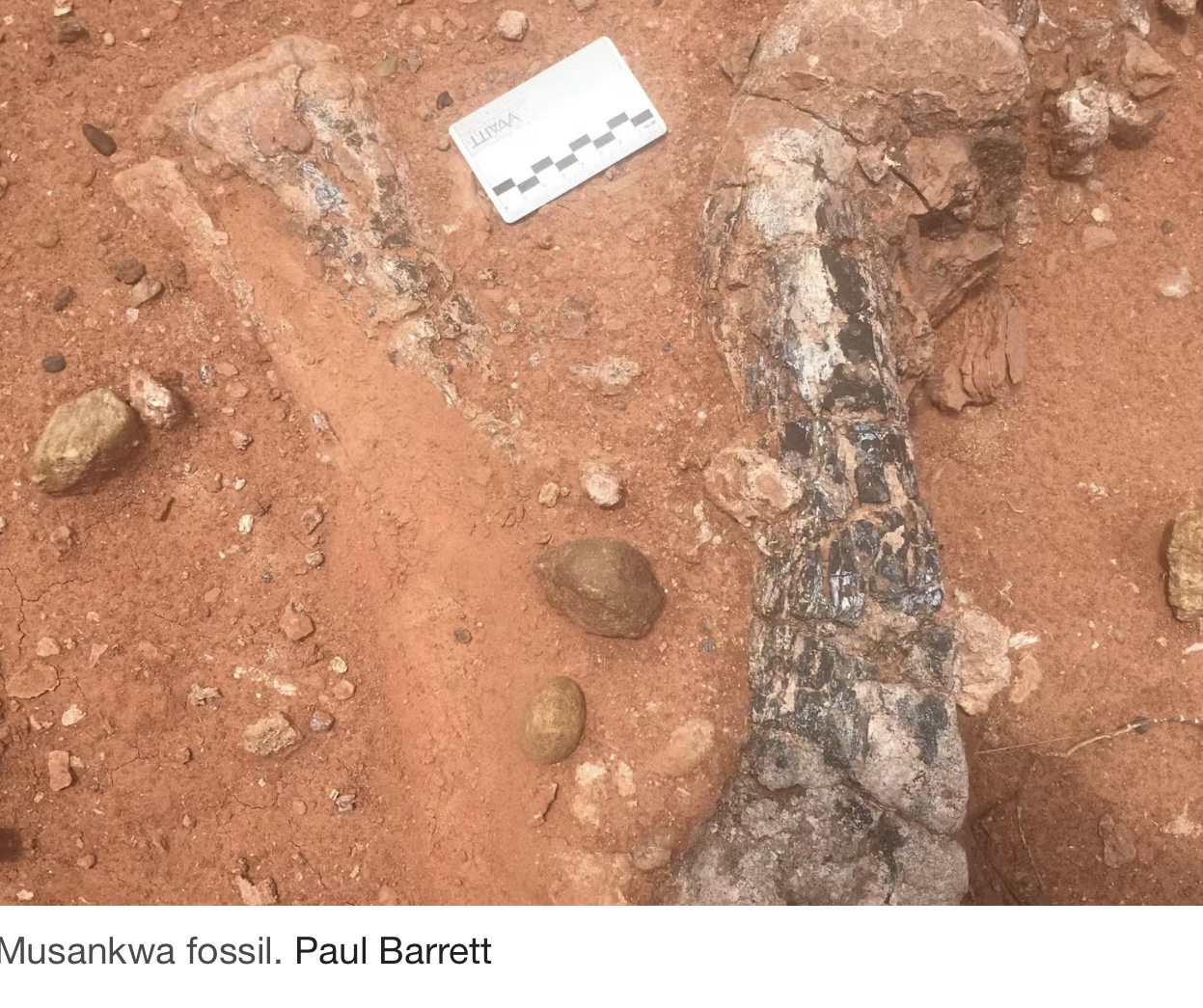
What unites these African dinosaurs is their mosaic of primitive and advanced traits. Musankwa’s robust limb bones and unusual ankle suggest adaptations for traversing rugged terrain. Massospondylus exhibits early traits seen in later sauropods, such as air‑filled vertebrae that lightened the skeleton. Jobaria, from the Early Cretaceous, combined a long neck with strong, pillar‑like limbs, hinting at a transition between smaller sauropodomorphs and the giant titanosaurs. Together, they show that Africa was a testing ground for dinosaur diversity.
Preserving and studying these fossils poses challenges. Political instability, limited funding and the sheer remoteness of many sites mean that discoveries often rely on collaborations between local scientists and international teams. The success of Musankwa’s description demonstrates the value of such partnerships. As museums across Africa expand their collections and training programmes, a new generation of palaeontologists is poised to uncover more treasures. For dinosaur fans, this means the next big breakthrough could come from a hillside in Zimbabwe, Zambia or Tanzania.
Ultimately, the fossil market reflects the broader tension between scientific value and financial incentive. Dinosaurs have enormous cultural appeal, and wealthy individuals may see fossils as both investments and works of natural art. Scientists, meanwhile, stress that fossils are irreplaceable data points for understanding evolution and past environments. Open dialogue between collectors, dealers, scientists and governments is essential. By recognising both the legitimate interests of collectors and the public interest in scientific heritage, we can hope to build a system where spectacular fossils enrich both private collections and the scientific record.
Credit: American Museum of Natural History